
How AI Is Changing Search Engine Optimization
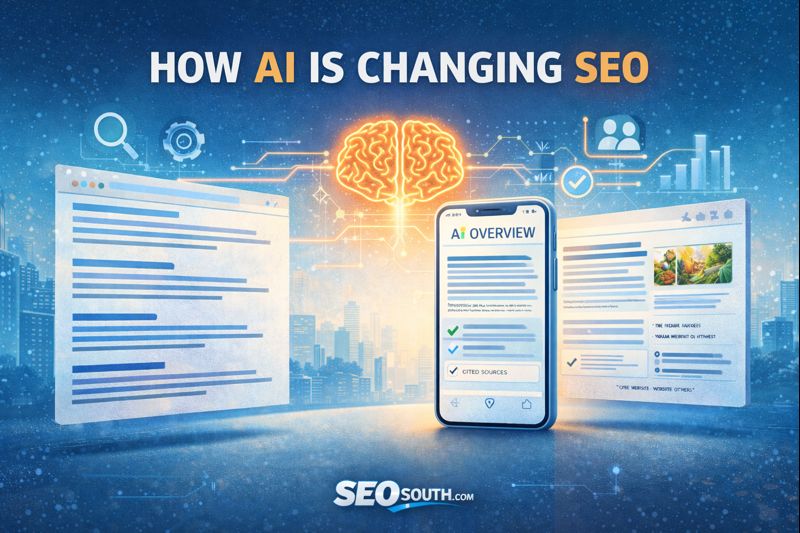
Search results do not look the way they did even a year ago. If you are paying attention, you have probably noticed fewer traditional blue links and more summaries, previews, and direct answers appearing at the top of the page. This shift is not subtle, and it is not temporary.
AI is actively reshaping how search engines present information, how users interact with results, and how websites earn visibility. For business owners and site managers, this raises an important question. If search engines are answering questions directly, where does that leave your website?
The answer is not to panic or abandon SEO. It is to understand what is changing and adjust how your site is built, structured, and maintained over time.
What Google AI Overviews Mean for Search Visibility
Google has begun rolling out AI generated summaries at the top of many search results. These overviews pull information from multiple sources and present a consolidated answer directly on the results page. Google refers to these as AI Overviews.
You can learn more directly from Google here: https://blog.google/products/search/generative-ai-search/
From a user perspective, this feels convenient. From a website owner perspective, it can feel disruptive.
AI Overviews often reduce the need for users to click through multiple links. In some cases, the answer they need is already visible. This has led to a rise in what are known as zero click searches, where users complete their task without ever visiting a website.
This does not mean websites are no longer relevant. It means search engines are becoming far more selective about which sources they trust enough to feature.
The Rise of Zero Click Searches
Zero click searches are not new, but AI has accelerated them significantly.
Featured snippets, knowledge panels, local packs, and AI generated summaries are all designed to satisfy intent quickly. For simple informational searches, the click may never happen.
According to research published by SparkToro, a large percentage of Google searches now end without a click to another website.
However, this trend only applies to certain types of searches.
Users still click when they need depth, comparison, trust, or action. Legal guidance, service providers, technical explanations, healthcare information, and purchasing decisions still require complete websites and credible sources.
The key difference is that search engines are now choosing which websites they trust enough to summarize.
If your content is unclear, poorly structured, outdated, or shallow, it becomes far less likely to be included in those results.
Why Structured Content Still Wins
This is where many businesses misunderstand what AI driven search actually rewards.
AI does not replace structure. It depends on it.
Search engines and language models rely heavily on clear signals to understand content. That includes proper heading structure, logical flow, descriptive subtopics, internal linking, and structured data where appropriate.
Google has consistently emphasized the importance of helpful, people first content through its Helpful Content guidelines.
Well structured content is easier to parse, easier to summarize, and easier to trust.
When a page clearly answers a question, breaks down concepts logically, and avoids unnecessary filler, it becomes a much stronger candidate for inclusion in AI summaries and featured results.
This is not about keyword stuffing or manipulating algorithms. It is about clarity, usefulness, and topical relevance.
What Website Owners Should Be Doing Right Now
The fundamentals matter more than ever.
First, your website structure needs to be clean. Pages should have a clear hierarchy with headings that reflect real topics rather than visual styling choices alone. Content should flow naturally from introduction to explanation to supporting detail.
Second, content needs to demonstrate real understanding and expertise. AI systems are increasingly effective at identifying thin content and low value pages. Websites built only to rank without offering meaningful insight are steadily losing visibility.
Third, accessibility and readability are no longer optional. Sites that are easy to read, easy to navigate, mobile friendly, and easy to interpret send strong quality signals.
The W3C Web Accessibility Initiative offers excellent guidance for improving usability and accessibility standards.
These improvements benefit users, search engines, and AI systems equally.
Fourth, stop chasing shortcuts and start building foundations. AI changes the interface of search, but not the underlying goal. Search engines still want to provide the best possible answer to the user.
Your job is to become a trusted source worth referencing.
Why SEO Is Becoming More Transparent
There is a lot of noise claiming that AI will eliminate SEO. In reality, it is forcing the industry to mature.
Shortcuts are becoming less effective. Low effort pages are losing visibility. Websites built with intention, expertise, and structure are standing out.
SEO today is less about exploiting weaknesses in algorithms and more about earning trust through clarity, consistency, performance, and genuinely useful content.
That shift is ultimately good for both users and businesses.
Companies that invest in solid content, thoughtful design, and long term strategy are not disappearing from search. They are becoming the sources AI systems rely on.
The Opportunity Most Businesses Are Missing
AI driven search creates a different kind of visibility.
Even when users do not immediately click through to your website, your brand can still appear as a cited source within summaries and AI generated responses. Over time, that visibility builds recognition, authority, and trust.
But this only happens if your website is readable, well structured, technically sound, and credible.
Websites built as afterthoughts will slowly fade into the background. Websites built with purpose will continue compounding in value.
This is why SEO, content strategy, accessibility, and web design can no longer operate as separate disciplines. Structure, content quality, user experience, and performance all work together.
AI is changing how search results are displayed, but it is not changing the core principle behind search engines.
The best answer still wins.
If your website is clear, well organized, technically sound, and genuinely useful, it can continue earning visibility in both traditional and AI powered search results.
For business owners, the path forward is straightforward. Build content that helps real people, structure it properly, and focus on long term quality instead of short term tricks.